Why Branded Treats Are a Smarter Marketing Spend Than You Think
Most marketing budgets are crowded with line items that are hard to measure. Digital ad impressions, sponsored posts, swag that ends up in a drawer — businesses pour money into touchpoints and hope something sticks. Against that backdrop, an unlikely contender has been quietly delivering some of the best engagement-per-dollar in the business: edible branding. Custom-decorated treats sent to clients, prospects, and staff are turning out to be a far shrewder use of marketing spend than their modest price suggests.
It sounds frivolous until you look at the economics. A single sponsored social post might cost more than a box of branded cupcakes for corporate events and reach people who scroll past it in half a second. The cupcakes, by contrast, get photographed, shared around an office, and remembered. For a category of spend that often runs to just a few dollars per recipient, the return on attention is hard to beat. This piece breaks down why, and how to think about edible gifting as an investment rather than an indulgence.
The attention math
Marketing is ultimately a competition for attention, and attention has never been more expensive. The average professional is bombarded with hundreds of digital messages a day, and the cost of cutting through climbs every year. Branded food does something most channels can’t: it arrives as a welcome surprise rather than an interruption.
When a box of custom treats lands in an office, it doesn’t get ignored — it gets opened, discussed, and very often posted to social media by the recipients themselves. That last part is the quiet multiplier. A company spends on a single delivery and receives, in return, organic social content created and distributed by the people they were trying to reach. You can’t buy that authenticity through an ad platform at any price.
Cost per impression, reconsidered
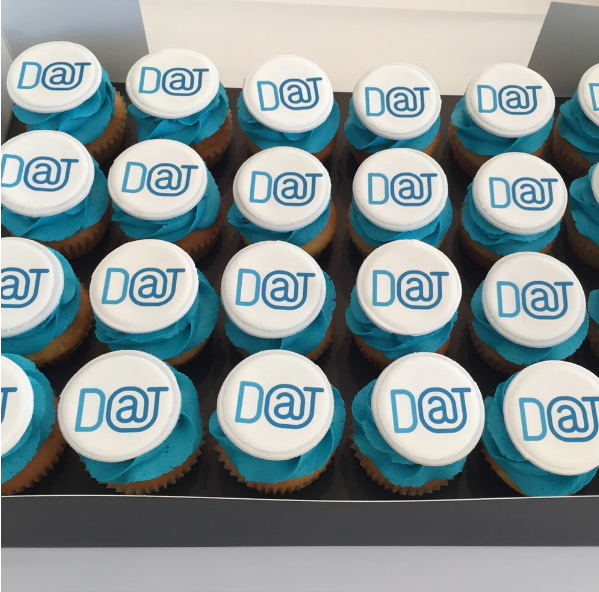
Run the numbers and the case sharpens. Suppose a business sends a box of two dozen logo-printed cupcakes to a client’s office for a product launch. The direct cost is modest. But those cupcakes are seen by everyone in the office, not just the contact — receptionists, the wider team, anyone walking past the break room. Several people photograph them. A couple post to LinkedIn or Instagram, tagging the sender.
Suddenly a small, fixed cost has generated dozens of genuine impressions, several pieces of user-generated content, and a warm association with the brand, all without a media buy. Measured as cost per meaningful impression, edible branding frequently outperforms the digital channels sitting next to it on the budget line.
Where it works hardest
Branded treats aren’t a fit for every objective, but in a few scenarios they’re remarkably effective.
Client retention and thank-yous. Relationships are the lifeblood of most B2B businesses, and a personalised gift at the right moment — a contract signed, a project delivered, a year of partnership — reinforces them at a fraction of the cost of losing and replacing a client.
Product launches and events. Branded cupcakes or cookies at a launch give attendees something tangible and photogenic, extending the event’s reach onto social media and into conversations that happen afterward.
Office culture and retention. Internal spend matters too. Celebrating birthdays, milestones, and wins with branded treats is a low-cost contributor to the kind of workplace culture that keeps good staff from leaving — and staff turnover is one of the most expensive line items a business has.
Sales prospecting. A thoughtful, branded delivery to a target account opens doors that cold emails can’t. It’s memorable precisely because almost nobody else is doing it.
The credibility signal
There’s a subtler reason custom treats punch above their weight: they signal that a business cares about details. Anyone can send a generic gift basket bought in bulk. A box where the icing carries your logo, matched to your brand colours and delivered fresh, communicates effort and competence. Recipients read that signal, consciously or not, and transfer the impression to how they imagine you handle everything else.
For small and mid-sized businesses especially, this is a cheap way to appear more established than the headcount suggests. Punching above your weight on presentation is one of the highest-leverage moves a growing company can make, and edible branding is one of the most affordable ways to do it.
Doing it without wasting the money
Like any spend, branded treats can be done well or poorly. A few principles keep the ROI intact.
Choose quality over quantity — a small box of genuinely good treats outperforms a large order of mediocre ones, because the goal is a positive association, not volume. Prioritise suppliers who handle the logistics reliably, since a gift that arrives late or damaged does more harm than no gift at all; same-day delivery and dependable corporate accounts matter here. Pay attention to dietary inclusivity, because a treat half the office can’t eat undermines the gesture — nut-free, gluten-free, and vegan options ensure nobody is left out. And keep the branding tasteful; the logo should enhance the gift, not turn it into a billboard nobody wants to eat.
The bottom line
In a marketing landscape obsessed with digital metrics, it’s easy to overlook the channels that work precisely because they’re physical and personal. Branded treats occupy a sweet spot: low absolute cost, high memorability, built-in social amplification, and a credibility signal that’s hard to fake. For businesses looking to stretch a marketing budget further, the humble decorated cupcake may be one of the smartest line items they’re not yet using. Measured honestly against the alternatives competing for the same dollars, it earns its place on the spreadsheet.