Best Indoor Golf Simulator: How to Choose the Perfect Home Golf Simulator
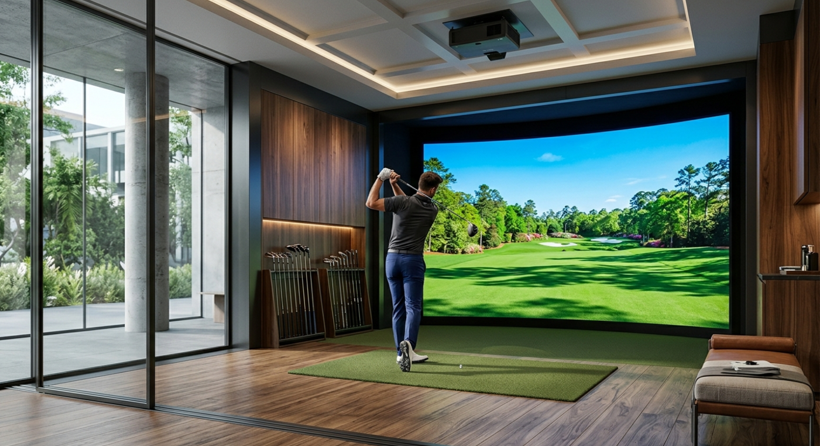
Golf used to stop when the weather turned. Not anymore. A well-set-up indoor golf simulator gives you access to accurate practice data, world-famous virtual courses, and full-swing feedback from whatever room you’ve converted into a bay: year-round, any time of day. The market has expanded fast enough that the choice isn’t just “get a simulator” anymore. It’s “get the right one for your space, your game, and your budget.” This guide walks through exactly what separates a great home golf simulator from an expensive disappointment.
Why More Golfers Are Choosing Indoor Golf Simulators?
It is no secret that a shift from traditional indoor golf simulators has been growing for years. A fully fitted-out home golf sim eliminates just about every practical barrier to regular training.
Being outside requires coordination of tee times, battling the elements, and getting little to no actionable feedback on what happened in a swing. An indoor golf simulator eliminates all three problems simultaneously. You practice when it suits you, in any conditions, with precise shot data after every swing. Virtual course libraries bring famous layouts to your home or garage golf simulator bay. The format works for families, for golfers preparing for competitive rounds, and for anyone who simply wants to hit more balls without driving to a range. The quality of current indoor golf simulator technology has crossed a threshold where the experience is genuinely useful rather than a novelty.
What Makes the Best Indoor Golf Simulator?
Not every simulator is equal, and the differences that matter most aren’t always the ones most prominently marketed. Here’s what to look at in each component before deciding what the best golf simulator is for your situation.
- Launch monitor accuracy: This is the foundation of everything. Camera-based systems excel in compact indoor spaces. Radar-based systems deliver exceptional accuracy in larger rooms but require more calibration space. Here, the right choice depends on your room dimensions and how you’ll use the data.
- Golf simulator software: The course library, practice modes, swing analytics, and user interface all live in the software. A hardware investment is only as useful as the software interpreting its data. Look for a platform with a large library and analytics tools specific enough to be useful.
- Tracking technology: Cameras have data due to the visual field, infrared focuses on area temperature, while radar and hybrid systems have different specialties. Radar systems require more room and depth, while camera-based systems are ideal for low ceilings. For the vast majority of home golf simulator setups, you want a good balance of accuracy vs flexibility, which is what hybrid systems offer.
- Visual quality: A short-throw projector with 4K resolution and at least 3,500 lumens of brightness is the starting point for a visually immersive experience. The screen must be durable enough to absorb thousands of ball impacts without degrading the image.
- Hitting experience: The mat surface affects both shot feel and data accuracy. Multi-surface mats that replicate fairway, rough, and tee box conditions are worth the investment over flat single-surface options.
- Ease of installation: A garage golf simulator or basement setup needs to work within the existing ceiling height, room width, and power configuration. Some systems are self-contained and straightforward; others require professional calibration. Match the installation complexity to your actual DIY capability.
How to Choose the Best Indoor Golf Simulator?
Buying the wrong simulator is expensive to fix. This step-by-step process removes most of the uncertainty from your decision.
Step 1: Set Your Budget
Establish both your initial budget and a realistic ceiling for installation and peripheral costs. Entry-level indoor golf simulator setups and quality home golf simulators both vary significantly when it comes to a complete, reliable system. Know both numbers before evaluating anything.
Step 2: Measure Your Room
Ceiling height is the most common constraint. 9 feet is the practical minimum; 10 feet is comfortable for most golfers. Measure depth (15+ feet preferred), width (12+ feet), and note where power outlets are positioned. A garage golf simulator with 8-foot ceilings may require a different launch monitor type than a dedicated room.
Step 3: Choose Your Launch Monitor
Match the monitor type to your room. For lower ceilings and compact spaces, overhead camera systems avoid the calibration and space issues that radar units can introduce. For larger rooms with full ceiling clearance, radar-based systems deliver excellent accuracy across the full data set.
Step 4: Select Your Software Platform
Decide on the software before finalizing hardware, since not every launch monitor is compatible with every platform. Evaluate the course library, analytics depth, multiplayer functionality, and update cadence. A platform actively developed as well as updated is worth more than a static one with a larger initial library.
Step 5: Choose Screen and Projector Together
The screen and projector should be specified as a pair. The screen size determines throw distance; throw distance determines projector type. Short-throw projectors fit most home golf simulator rooms better than standard throw lenses. Prioritize screen durability alongside brightness and resolution.
Step 6: Plan Installation Before Purchase
Confirm ceiling height, room depth, power supply, and any structural modifications needed before ordering anything. Returning a projector mount or enclosure because measurements were off is an avoidable complication.
Step 7: Test Before Finalizing
If at all possible, use the specific system you’re considering before purchasing, either at a commercial venue or through a dealer demonstration. The feel of the hitting mat, the visual quality of the screen, and the software response time are all easier to evaluate in person than on a specification sheet.
See also: Lifeguard Gear Essentials: What You Need for the New Lifeguarding Season
Common Mistakes When Buying a Golf Simulator
Most buyer regrets in the indoor golf simulator market trace back to the same predictable errors.
- Buying based only on price: The cheapest system that fits your budget is rarely the most cost-effective choice. A simulator that underperforms quickly loses its value for practice.
- Ignoring room dimensions: Ceiling height and room depth drive more purchase decisions than any spec sheet. Measure first, don’t assume a standard room works.
- Choosing the wrong projector: Brightness matters as much as resolution in a room that isn’t completely light-controlled. Undershooting on lumens produces a washed-out image that degrades the experience significantly.
- Buying poor-quality mats: A cheap flat mat affects both data accuracy and physical feel. The hitting surface is what you interact with most; it’s not where to cut corners.
- Ignoring software: Hardware is only as good as the software interpreting it. A launch monitor without a strong platform backing it produces data with no practical context.
- Not considering upgrades: A closed ecosystem with no upgrade path locks you into today’s configuration permanently. Choose a system where components can be replaced or improved independently.
Conclusion
For serious golfists, a good indoor golf simulator is definitely one of those investments that most always pays off in the long run. It has all reached the stage where the data is accurate, courses offer genuine immersion, and the practical benefits: access to year-round practice, instant feedback, and no influence of weather on one’s performance are not conceptual but tangible. It all comes down to finding components that will suit your space and your purpose. Do it by measuring wherever possible, testing where you can, and then focusing on what matters in terms of performance over appearance.